
Running a gym successfully requires more than quality equipment, experienced trainers, and a steady flow of new members. Behind every well-managed fitness business is a reliable system for handling memberships, tracking payments, organizing staff, monitoring attendance, and maintaining financial control.
For many gym owners, the biggest challenge is managing multiple responsibilities at once. Membership renewals may be overlooked, payments can become difficult to track, and daily administrative work can take time away from improving the member experience.
The best way to manage a gym is to create consistent processes for membership management, payments, attendance, staff, finances, and member retention.
Whether you own a small independent gym, a fitness studio, or multiple locations, this guide explains how to manage a gym effectively, avoid common operational mistakes, and build a more organized fitness business.
1. Understand the Fundamentals of Gym Management
Gym management involves planning, organizing, and overseeing the activities needed to operate a fitness facility efficiently.
A gym owner or manager is typically responsible for:
- Managing member registrations and membership plans.
- Tracking membership payments and outstanding fees.
- Recording attendance and daily check-ins.
- Managing employees and personal trainers.
- Maintaining equipment and facility cleanliness.
- Monitoring income, expenses, and business performance.
- Handling member inquiries, renewals, and cancellations.
- Planning marketing and future business growth.
These activities are interconnected.
For example, poor membership tracking can result in missed renewals. Inaccurate payment records can create financial confusion, while ineffective staff coordination can negatively affect customer service.
Successful gym management starts by ensuring that every important operational task has a clear process and a responsible person.
Create a simple gym management system
Start by dividing your business into five areas:
- Memberships: Registration, plans, renewals, and member records.
- Finance: Payments, expenses, receipts, and reporting.
- Operations: Check-ins, equipment, maintenance, and daily tasks.
- Staff: Employee responsibilities, schedules, and performance.
- Growth: Member retention, marketing, and customer feedback.
Review each area regularly rather than waiting until problems become serious.
2. Organize Gym Membership Management
Membership management is the foundation of an organized fitness business.
Every gym should maintain accurate information about its members, membership plans, payment status, and expiration dates.
When these records are scattered across notebooks, spreadsheets, and messaging apps, it becomes harder to provide consistent service.
What information should you track?
A useful membership record may include:
| Information | Purpose |
|---|---|
| Member name | Identify the member |
| Contact details | Membership communication |
| Membership plan | Track the purchased package |
| Start date | Identify membership coverage |
| Expiry date | Monitor upcoming renewals |
| Payment status | Identify outstanding amounts |
| Attendance history | Understand facility usage |
Only collect information genuinely needed for your operations, and protect member data appropriately.
Standardize the registration process
Create a clear process for every new member:
- Register their basic information.
- Select the agreed membership plan.
- Confirm the membership start and expiry dates.
- Record the payment and issue a receipt.
- Explain gym policies and available services.
- Provide an introduction to the facility.
A standardized process reduces errors and makes it easier for employees to handle registrations consistently.
Monitor upcoming membership expirations
Review memberships approaching their expiration dates every day.
For example, staff can prepare a list of memberships expiring within the next seven days and send reminders to members who have agreed to receive them.
This helps reduce forgotten renewals and gives members time to decide whether to continue.
Gym management tip: Keep active, expired, cancelled, and temporarily frozen memberships clearly distinguished. These categories should not be confused with payment status.
3. Track Gym Membership Payments and Outstanding Fees
Payment tracking is one of the most important responsibilities when managing a gym.
A fitness business may accept payments through cash, bank transfers, cards, or digital wallets. Without accurate records, reconciling collections becomes difficult.
Record every membership payment
For each payment, record:
- Member name or membership reference.
- Payment date.
- Amount charged.
- Amount received.
- Payment method.
- Any outstanding balance.
- Receipt or transaction reference.
- Employee who recorded the payment.
Make sure that expected payments and completed transactions are recorded separately.
Example: Monthly membership collections
Suppose your gym has 100 members with a monthly membership fee of $50.
The expected membership value would be:
100 members × $50 = $5,000
However, assume only 90 members have paid for the month.
The actual amount collected would be:
90 members × $50 = $4,500
The remaining $500 represents payments that need reconciliation. Depending on the circumstances, some members may have unpaid renewals, approved adjustments, or memberships that did not renew.
This example demonstrates why membership counts should never be treated as proof of collected revenue.
Establish a daily payment review
At the end of each business day:
- Review all recorded transactions.
- Reconcile cash collections.
- Compare bank and digital payment records.
- Investigate unexplained differences.
- Record refunds or adjustments separately.
- Prepare a daily collection summary.
This routine improves financial visibility and makes payment discrepancies easier to identify.
4. Improve Gym Attendance Tracking
Attendance tracking helps gym owners understand how members use the facility.
Accurate check-in data can answer important questions:
- How many members visited today?
- Which hours are busiest?
- Which members have stopped attending regularly?
- How many visits does the gym receive each week?
- Does the facility need additional staff during peak hours?
Choose a reliable check-in process
A gym may use reception-based member lookup, digital registers, QR codes, membership cards, or other supported check-in methods.
The best approach depends on the gym's size, budget, and operational needs.
Whatever method you choose, attendance records should be connected to the correct member.
Review attendance trends
Suppose a member previously visited four times per week but has not attended for two weeks.
This change may be worth a friendly follow-up.
Staff could ask whether the member needs scheduling assistance or additional training support.
However, low attendance does not automatically mean dissatisfaction. Members may have personal, health, travel, or work-related reasons for missing sessions.
Use attendance information to improve service rather than making assumptions.
Identify peak gym hours
Review the busiest times of day and adjust staffing or facility operations accordingly.
If your gym receives most visits between 5 PM and 8 PM, you may need additional reception support, better equipment availability, or adjusted cleaning schedules during that period.
5. Manage Gym Staff and Personal Trainers Effectively
Good gym management requires clear staff responsibilities.
Even a small fitness facility benefits from organized employee schedules, defined roles, and regular communication.
Define staff responsibilities
| Staff Role | Typical Responsibilities |
|---|---|
| Gym Manager | Daily operations and business coordination |
| Reception Staff | Registrations, check-ins, payments, and inquiries |
| Personal Trainers | Coaching, workout guidance, and member support |
| Cleaning Staff | Facility cleanliness and hygiene |
| Gym Owner | Financial oversight and business decisions |
Some employees may handle several responsibilities, particularly in smaller gyms.
The important point is that employees understand what is expected of them.
Track staff schedules and attendance
Maintain a system for recording:
- Working hours and shifts.
- Employee attendance.
- Leave and absences.
- Assigned responsibilities.
- Relevant payroll information.
Review schedules regularly to ensure sufficient staffing during busy periods.
Protect sensitive business records
Employees should only receive access to information required for their responsibilities.
For example, trainers may need relevant client records, while financial settings should remain restricted to authorized personnel.
Use appropriate access controls and remove unnecessary permissions when employee responsibilities change.
6. Keep Daily Gym Operations Organized
Daily operations have a direct impact on member satisfaction and business reliability.
A gym should have repeatable procedures for opening, closing, cleanliness, equipment maintenance, and customer support.
Create a daily opening checklist
Before members arrive:
- Check facility cleanliness.
- Inspect essential equipment.
- Confirm staff availability.
- Check emergency exits and safety equipment.
- Prepare the reception area.
- Confirm that membership and check-in systems are functioning.
Create a closing checklist
At the end of the day:
- Reconcile collected payments.
- Check equipment for reported problems.
- Record unresolved member issues.
- Complete cleaning requirements.
- Secure the building.
- Prepare important tasks for the following day.
Maintain gym equipment regularly
Equipment maintenance should be planned rather than handled only after something breaks.
Keep records of equipment inspections, faults, repairs, and scheduled servicing.
Follow manufacturer recommendations and relevant local safety requirements.
Reliable equipment, a clean environment, and well-organized staff all contribute to a better gym experience.
7. Monitor Gym Revenue, Expenses, and Financial Performance
A gym can have many members and still experience cash-flow problems.
Understanding revenue and expenses is essential for long-term sustainability.
Track different revenue sources
Depending on your business, revenue may include:
- Monthly memberships.
- Personal training services.
- Group fitness programs.
- Product sales.
- Other fitness-related services.
Separate these revenue categories so you can identify which parts of the business perform well.
Monitor gym operating expenses
Typical gym expenses may include rent, utilities, employee salaries, equipment maintenance, cleaning, marketing, and software subscriptions.
Keep business expenses separate from personal spending.
The U.S. Small Business Administration recommends maintaining organized financial records and understanding business cash flow, expenses, assets, and liabilities.
Review your financial results monthly
Ask yourself:
- How much revenue did the gym generate?
- How much money was actually collected?
- What were the total operating expenses?
- Which services contributed the most revenue?
- Are outstanding payments increasing?
- Which costs require attention?
A simple monthly financial review can reveal problems that daily sales figures might not show.
Practical tip: Profit and cash flow are different. Record both accurately, and consult a qualified accountant when necessary.
8. Improve Gym Member Retention
Getting new members is important, but maintaining strong relationships with existing members is also essential.
According to the Health & Fitness Association's 2025 Fitness Industry Benchmarking Report, the operators included in its research reported an average annual member retention rate of 66.4%.
The report analyzed information from 175 fitness companies representing facilities across 27 countries. This figure is a benchmark for that sample, not a guaranteed industry-wide target for every gym.
Improve the onboarding experience
New members should receive clear information about membership terms, gym facilities, training support, and whom to contact for assistance.
Follow up with inactive members
Use attendance patterns to identify members who may benefit from support.
A helpful message or conversation can reveal problems with scheduling, motivation, or the gym experience.
Collect member feedback
Ask members about their experience and identify recurring issues.
Feedback can help improve equipment availability, customer service, cleanliness, and training programs.
Monitor renewals and cancellations
Review why members choose to renew or cancel.
Keep track of these reasons where appropriate, and use the information to improve services.
Member retention deserves its own strategy. It should not be treated as a task that only begins when a membership is about to expire.
For more ideas on improving renewals and reducing cancellations, explore our 14 practical gym member retention strategies.
9. Track Essential Gym Management KPIs
Key performance indicators, or KPIs, help gym owners evaluate business performance.
You do not need dozens of complicated reports. Start with a few metrics that support meaningful decisions.
| KPI | What It Tells You |
|---|---|
| Active memberships | Number of members with valid memberships |
| New memberships | Number of members joining during a period |
| Membership renewals | Number of memberships renewed |
| Payment collection rate | Share of due payments actually collected |
| Attendance participation | Percentage of active members visiting during a period |
| Member retention rate | Percentage of existing members retained |
| Monthly revenue | Revenue generated during the month |
| Operating expenses | Cost of running the gym |
Example: Payment collection rate
Suppose $10,000 in membership payments was due this month, and the gym collected $9,000.
Collection rate = ($9,000 ÷ $10,000) × 100 = 90%
This tells the owner that 90% of the amount due has been collected.
Example: Weekly participation rate
Suppose a gym has 200 active members, and 120 distinct active members check in at least once during a week.
Weekly participation = (120 ÷ 200) × 100 = 60%
This metric helps identify participation patterns, but it does not measure how often each individual exercised.
Review KPIs consistently and use the same definitions when comparing reporting periods.
10. Manage Multiple Gym Locations Efficiently
Operating several gym branches introduces additional management challenges.
Each location may have separate staff, members, expenses, and daily transactions.
Without consistent processes, owners may struggle to understand the performance of individual branches.
Establish branch-level records
Maintain accurate information for each location, including:
- Active members.
- Membership revenue.
- Payments and outstanding balances.
- Staff assignments.
- Attendance activity.
- Operating expenses.
- Maintenance requirements.
Standardize operating procedures
Use consistent methods for registrations, payment records, receipts, staff access, and reporting.
Where appropriate, review both individual branch results and consolidated business performance.
For growing businesses, Kynavora's multi-branch management solution explains how supported locations can be managed with improved operational visibility.
11. Common Gym Management Mistakes to Avoid
Many operational problems arise from a small number of recurring mistakes.
Mistake 1: Forgetting membership renewals
Solution: Review upcoming expirations regularly and maintain accurate renewal records.
Mistake 2: Mixing business and personal finances
Solution: Maintain separate business records and reconcile financial transactions.
Mistake 3: Focusing only on acquiring new members
Solution: Give existing member satisfaction, engagement, and retention consistent attention.
Mistake 4: Having unclear staff responsibilities
Solution: Assign specific duties and review them regularly.
Mistake 5: Ignoring equipment maintenance
Solution: Establish inspections, preventive maintenance, and fault-reporting procedures.
Mistake 6: Making decisions without reliable data
Solution: Review membership, payment, attendance, and financial reports.
Mistake 7: Introducing software without training staff
Solution: Document processes and train employees before expecting them to use a new system consistently.
Improving these areas can make daily gym operations easier to control.
12. Build a Daily, Weekly, and Monthly Gym Management Checklist
A practical gym management checklist helps ensure that important activities are not overlooked.
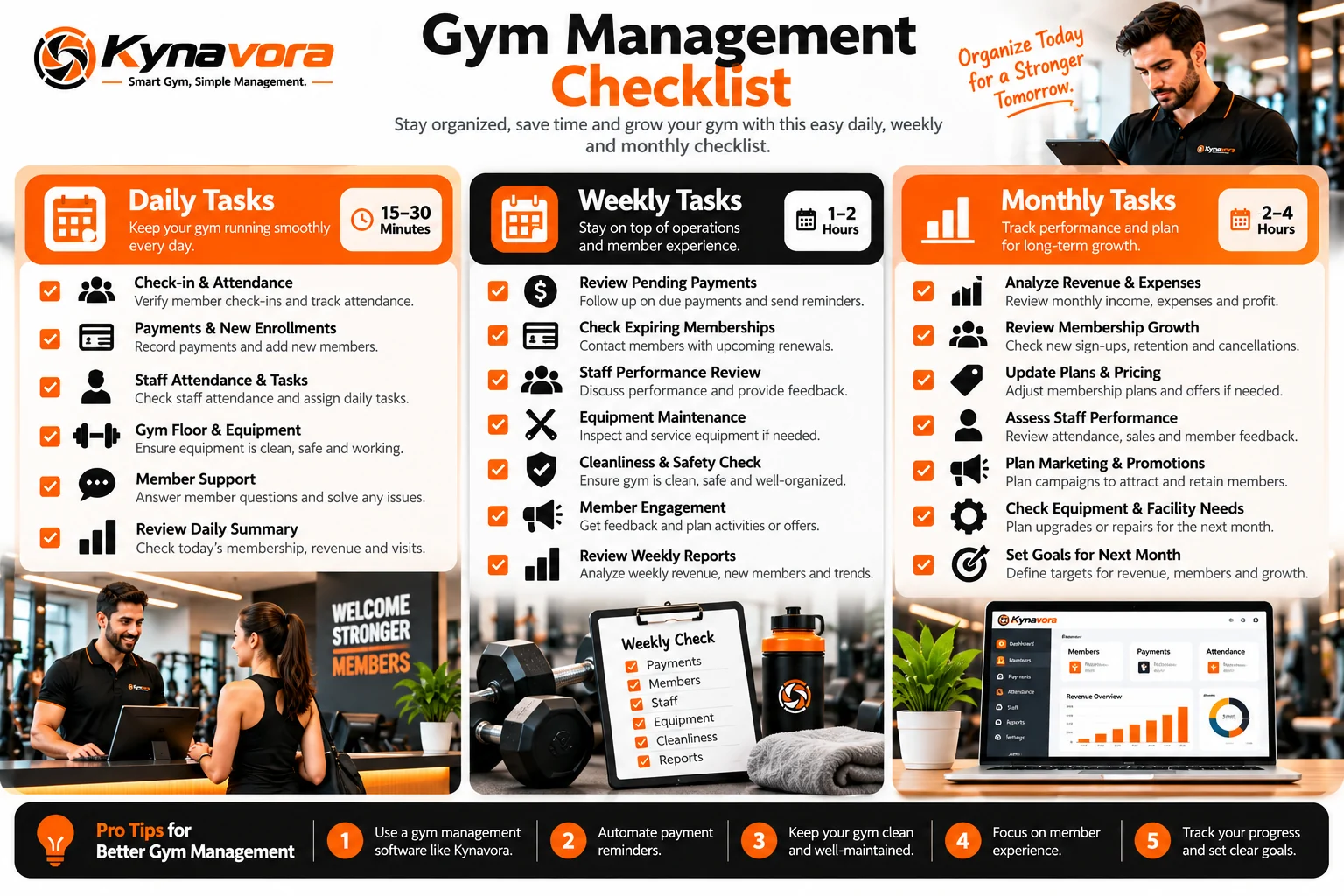
Daily Gym Management Checklist
- Review memberships expiring soon.
- Check member registrations and renewals.
- Reconcile payments received.
- Monitor check-in and attendance activity.
- Confirm staff availability.
- Respond to important member inquiries.
- Record equipment and facility problems.
- Review outstanding administrative issues.
Weekly Gym Management Checklist
- Review active and expired memberships.
- Check unpaid balances.
- Evaluate attendance patterns.
- Discuss operational issues with staff.
- Follow up on relevant member feedback.
- Review maintenance requirements.
- Compare weekly revenue and expenses.
Monthly Gym Management Checklist
- Prepare revenue and expense reports.
- Review member retention and cancellations.
- Evaluate marketing inquiries and conversions.
- Review staff performance and responsibilities.
- Compare financial performance with previous months.
- Identify the most important operational improvements.
Assign responsibility for each task so the checklist becomes part of your regular workflow.
13. How Gym Management Software Can Help
Many small gyms begin by managing operations through notebooks, spreadsheets, or separate applications.
These methods may work initially, but managing information across different systems can become more difficult as the business grows.
Gym management software can help businesses organize operations such as:
- Member registrations and membership plans.
- Payment tracking and receipts.
- Check-in and attendance management.
- Staff administration.
- Revenue and expense records.
- Reporting and business visibility.
- Multi-branch operations.
However, software is only one part of effective gym management.
Gym owners still need clear procedures, trained employees, reliable information, and consistent follow-through.
Choosing the right system
Before selecting a platform, consider:
- Does it solve the gym's actual operational problems?
- Can employees learn and use it effectively?
- Does it support the necessary membership and payment workflows?
- Are staff access and business data appropriately protected?
- Can it support the business as it grows?
- Are its pricing and limitations clearly explained?
Kynavora is a gym and fitness business management platform designed to help owners organize key business operations.
Explore Kynavora gym management features or learn more about its gym and fitness center solution.
You can also review Kynavora pricing to understand the available plans and applicable market conditions.
14. A Practical 30-Day Gym Management Improvement Plan
Improving gym management does not require changing every process at once.
Start with a structured 30-day plan.
| Timeline | Focus Area | Recommended Action |
|---|---|---|
| Week 1 | Memberships | Review member records, membership plans, and expiry dates |
| Week 2 | Payments | Improve collection records, receipts, and reconciliation |
| Week 3 | Members | Review attendance, member feedback, and renewal follow-ups |
| Week 4 | Operations | Improve staff coordination, reporting, and daily checklists |
At the end of 30 days
Review whether:
- Membership records are more accurate.
- Outstanding payments are easier to identify.
- Staff responsibilities are clearer.
- Operational issues are handled more consistently.
- Financial performance is easier to understand.
Use these findings to choose your next improvements.
The goal is not to automate everything immediately. It is to build reliable processes that your gym can follow every day.
Frequently Asked Questions About Managing a Gym
What is the best way to manage a small gym?
Start with organized membership records, consistent payment tracking, staff responsibilities, and daily operating checklists. Review financial and membership performance regularly, using tools appropriate to your business.
How do I manage gym memberships effectively?
Maintain accurate member profiles, membership plans, start and expiry dates, payment records, and membership statuses. Review upcoming renewals and follow a consistent registration process.
How can I improve gym management without expensive software?
Begin with clear processes, accurate records, staff training, and regular reconciliation. Spreadsheets and simple tools may be sufficient for smaller gyms, provided information is managed securely and consistently.
What are the most important gym management KPIs?
Useful starting metrics include active memberships, new members, renewals, payment collection rate, attendance participation, member retention, revenue, and operating expenses.
How can I run a gym more successfully?
Focus on delivering a reliable member experience while improving operational systems. Keep financial records accurate, train employees, maintain equipment, and use performance data to identify opportunities for improvement.
Can gym management software replace a gym manager?
No. Software can help organize information and routine processes, but gym managers and staff remain responsible for customer service, leadership, safety, and business decisions.
Conclusion: Build a Gym That Runs More Efficiently
Learning how to manage a gym successfully is an ongoing process.
The strongest foundation comes from consistent membership management, accurate payment records, organized employees, reliable daily operations, and regular business performance reviews.
Start with your most important operational problems, introduce clear processes, and measure your progress over time.
As your gym grows, the right tools can help you manage increasing complexity without losing visibility into your business.
Want to organize your gym operations more effectively?
Book a Kynavora Demo to explore how the platform may fit your fitness business.